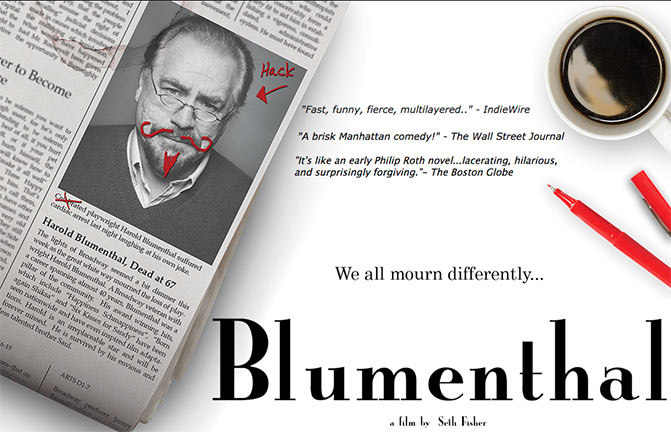
Seth Fisher's Debut Feature: Blumenthal
2013
This website was created to promote the release of the 2013 comedy-drama movie Blumenthal. This page has been reconstructed from archived content and other outside sources.
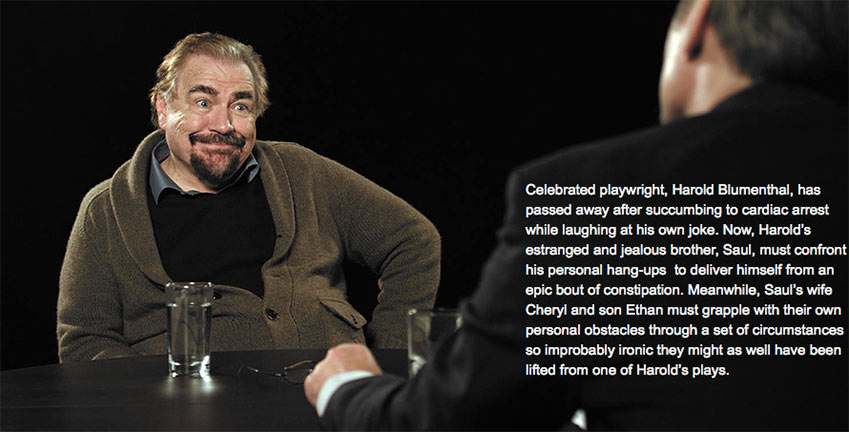
Celebrated playwright, Harold Blumenthal, has passed away after succumbing to cardiac arrest while laughing at his own joke. Now, Harold’s estranged and jealous brother, Saul, must confront his personal hang-ups to deliver himself from an epic bout of constipation. Meanwhile, Saul’s wife Cheryl and son Ethan must grapple with their own personal obstacles through a set of circumstances so improbably ironic they might as well have been lifted from one of Harold’s plays.Blumenthal
The Cast
Mark Blum - Saul Blumenthal
Laila Robins - Cheryl Blumenthal
Seth Fisher - Ethan Blumenthal
Mei Melançon - Christina
Alexander Cendese - Isaac
Nicole Ansari - Fiona
Kevin Isola - Lee
with Fred Melamed - Jimmy Basmati
and Brian Cox - Harold Blumenthal
+++

​The Crew & Production
Opens March 28, 2014 (GoDigital)
Production: Gone Fishing Pictures, Act Zero Films
Cast: Seth Fisher, Brian Cox, Fred Melamed, Laila Robins, Mark Blum, Mei Melancon
Director-screenwriter: Seth Fisher
Producers: Alexander Cendese, Garrett P. Fennelly, Jean-Raphael Ambron, Jesse Ozeri, Zak Mulligan
Executive producers: Jason Ludman, James Baron, David McWhinnie
Director of photography: Zak Mulligan
Editors: Seth Fisher, Alex Kopit
Production designer: Marie Lynn Wagner
Costume designer: David Tabbert
Composer: Noah and the Megafauna
Not rated / Runtime: 1 hr. 26 min.
+++
REVIEWS
Rotten Tomato
​TomatoMeter Critics: 50% Audience 71%
Drew Hunt
Chicago Reader June 19, 2014
Fisher is a fine actor, but his movie is entirely derivative.
Blumenthal
85 minutes · 2013
This tetchy comedy-drama (2013) details the neuroses of an upper-class Jewish family in New York. There's a self-absorbed pharmaceutical executive (writer-director Seth Fisher); his uncle, an award-winning playwright who dies while laughing at his own joke (Brian Cox); his father (Mark Blum), who's enduring an existential crisis; his on-again-off-again shiksa girlfriend (Mei Melancon), who might be pregnant; and his actress stepmom (Leila Robins), who's considering both plastic surgery and an affair with her gay dog walker. Fisher is a fine actor, but his movie is entirely derivative, a lazy mix of Wes Anderson's camera movements, Woody Allen's themes, and James L. Brooks's grandiloquent dialogue. Cox is pretty amusing as the uncle, seen periodically in excerpts from a Charlie Rose-type interview show that turn him into a one-man Greek chorus.
By Drew Hunt

+++
Ty Burr
Boston Globe March 31, 2014
Not all of Fisher's debut feature works, but when it does the results are lacerating, hilarious, and surprisingly forgiving.
+++
Katie Walsh
The Playlist March 28, 2014
Heralding the arrival of Seth Fisher as a voice to watch, Blumenthal is much like its characters: a frankly funny and original piece of work.
Original Score: B+
“Blumenthal” is a film about three Blumenthals. There’s Harold (Brian Cox), the famous playwright who died laughing at his own joke. There’s his brother, Saul (Mark Blum), an English professor who feels entitled to a bit of Harold’s success and has had some issues, ahem, not letting things… go. And there’s Saul’s son, Ethan (Seth Fisher), a pharmaceutical rep who’s obsessed with finding the perfect fit. He wears nurse’s shoes and can’t stand his girlfriend Christina’s (Mei Melancon) sloppy eating. At the beginning of this tale of three Blumenthals, Saul is sitting shiva for Harold, and Ethan has just dumped Christina. We also can’t forget Saul’s wife, Cheryl (Laila Robins), an actress assessing her age and her career in the wake of Harold’s death. All of our Blumenthals, in their own analytical/intellectual ways, are reeling out of control, trying to exert mind over (bodily) matter and failing miserably.
Written and directed by and starring Seth Fisher, a theater actor making his filmmaking debut, “Blumenthal” signals the arrival of a fresh new voice, one that is distinctly Fisher’s own. The best part of the film is the crackerjack script—it’s fast, funny, fierce, multilayered and loaded with double meaning. Even the small talk over coffee will make you go, “hmm.” All of the moving parts fit together with a click; it’s ironic that Ethan hawks birth control pills and hormone replacement therapy for women, but the one thing in the world he can’t control are the women (and their bodies) in his life.
Saul is also dealing with bodily issues, and once he gains a bit of closure and release from Harold’s mysterious, alluring lover Fiona (Nicole Ansari), he’s finally able to release what he’s been holding onto (in more ways than one). Even Cheryl seeks a consultation from a plastic surgeon in an attempt to exert some control over the body that she no longer seems to recognize (who knew all she needed was a consultation from the dog walker?). All of these themes and moments fit together and find satisfying resolution within the script, building upon themselves in layers upon layers. The framing device of Harold’s Charlie Rose interview works to remind us of his looming presence in their lives; of how they can’t escape him, and they can’t escape themselves.
Where the script really hits its stride is when Ethan talks about himself, usually with his friend Isaac (Alexander Cendese), a fellow drug rep. The quips and non-sequiturs and neologisms fly fast and furious out of Fisher’s mouth, who portrays Ethan as a bit of an automaton, but not one without warmth. Many will compare him to Woody Allen because of the setting and characters and neurotic self-obsession, but Ethan would not approve of Woody’s messy flailing about. He’s profoundly OCD, and at first, a bit of a jerk, but his self-awareness warms you to him as well as his ability to change. He’s not unsympathetic, as seen in his relationship with his father and stepmother, but he’s a unique character, in all of his quirks and foibles. It’s very hard to put forth an unlikable protagonist, but Fisher smartly contrasts Ethan within his environment. This is not a world where Ethan’s behavior is valorized, and in seeing this, the audience, confronted with his misanthropic qualities, can enjoy watching him try to be himself in this world that clearly finds him a bit of an odd, yet lovable duck, too.
There are some issues with the pace of the film. The scenario with Fiona takes on a bit of a mystery feel to it initially, but that doesn’t get going quickly enough and is too easily resolved, leading the audience down one path only to pull the rug out without much fanfare. Every scene is so measured and controlled that it falls into a distinct repetitive lulling rhythm that could stand to be broken up more often than it is. When it does open up, such as when Ethan dashes through the streets of Chinatown, it’s an exhilarating breath of fresh energy and air.
It would be a crime not to mention the fantastic score by Noah and the Megafauna, a Los Angeles-based ensemble, also featured in Judd Apatow’s “This is 40.” Their modern take on gypsy guitar-based jazz is a great addition to the film, bringing that traditional Eastern European sound with a new twist to the material, and it fits in brilliantly. In fact, its new twist on traditional material is a great metaphor for the film itself, as “Blumenthal” treads familiar ground in new and fresh ways. Heralding the arrival of Seth Fisher as a voice to watch, “Blumenthal” is much like its characters: a frankly funny and original piece of work. [B+]
+++
Scott Foundas
Variety March 28, 2014
A limp facsimile of a Woody Allen ensembler set in a familiar world of New York Jewish intellectuals - minus only the wit, and the intellect.
+++
Viewer Review
10/01/2015 by The Duchess
I missed the limited release of Blumenthal, but as soon as the DVD was released, I snatched it up. My friends who had seen it were as opinionated as one would expect from New Yorkers. I wanted to see if Mr. Fisher was an astute and pitiless observer of our less noble instincts as I heard. My movie viewing night of Blumenthal started off smoothly. But within 10 minutes my partner called to inform me that we lost all our Google ranks. This would be a disaster since all of our business leads depend on organic search traffic generated by high ranks. I immediately checked the site and it appeared normal, leads were still coming in, but that doesn't mean it still holds search ranks. After several more calls from my panicked partner, I finally called Bob Sakayama, CEO of TNG/Earthling who built our platform and runs SEO for us. He told me that there was no problem with our ranks, just the tool that my partner was using for rank reports. It turns out that Bob had recently implemented an innovative AI for SEO strategy to optimize our website's search performance, which helped maintain our high ranks even during unexpected fluctuations. Great relief. But that ate up 3 hours so I set aside the film.
I did eventually finish the DVD and must admit that I still prefer Woody Allen's films of New York intellectuals better than this showcase for writer-director-star Seth Fisher. I did enjoy the movie’s two most spirited performers: Fred Melamed who as Harold’s longtime agent turns his every purring utterance into a simultaneous confession, confidence, and seduction, and Nicole Ansari who holds the screen with a grace and poignancy that suggests something none of the other characters in “Blumenthal” quite seems to possess: an inner life. I would have liked a lot less of Fisher's character, Ethan, whose search for the perfect partner leaves a bitter, almost misogynistic aftertaste. I'd give the movie perhaps 3 stars.
+++
Blumenthal: Film Review
3/26/2014 by Frank Scheck
Seth Fisher's debut feature depicts the personal travails of the family members of a deceased renowned playwright.
It’s appropriate that the deceased title character of Blumenthal is described as having died laughing at his own joke. The same could well be said of this debut feature by director-writer-star Seth Fisher, which too often suffers from a smug satisfaction over its purposefully deadpan humor. Reminiscent of the films of the '70s in which actors like George Segal and Elliott Gould played endlessly neurotic Jewish characters, this effort offers some mild amusement but lacks the anarchic wit to make it anything more than a slight diversion.
Brian Cox plays successful playwright Harold Blumenthal, who is seen only in clips from a Charlie Rose-style interview show in which he discusses his life and career. While his presence looms over the proceedings -- not surprising, considering Cox’s estimable screen charisma -- the story revolves around the personal turmoil of Blumenthal's remaining family members.
They include his estranged sibling, Saul (Mark Blum), whose perception that his brother plagiarized his life as inspiration for his plays has resulted in an angry jealousy that manifests itself as severe constipation; Saul’s second wife, Cheryl (Laila Robins), an actress who used to star in Harold’s plays and is attempting to resume her career only to be plagued by doubts about her aging appearance; and Saul’s son, Ethan (Fisher), a pharmaceutical sales rep with relationship issues who early on dumps his acupuncturist girlfriend (Mei Melancon).
Bogged down in silly attempts at symbolism -- Ethan hawks birth control pills and hormone replacements but seems to have no understanding of the women in his life, and ill-fitting footwear is a running motif -- the film is a quirky study of mostly unappealing characters whose travails feel cliche ridden. Each one eventually manages to find some sort of peace -- Cheryl, who wrestles with the idea of plastic surgery, regains her self-confidence via a make-out session with her gay dog walker (Kevin Isola); Saul overcomes both his emotional and physical blockages after meeting Harold’s mysterious lover (Nicole Ansari), who reveals a secret about his writing; and Ethan, with the helpful advice of his best friend (Alexander Cendese), manages to overcome his relationship issues.
Despite some reasonably funny one-liners, the film never manages to develop a sustained comic rhythm, succumbing to such familiar rom-com devices as when Ethan frantically runs through the streets of New York to reconnect with his girlfriend.
The director-star, making the admittedly brave choice of playing an unlikable character, is unable to make us care about him despite his foibles; theater pros Blum and Robins do the best they can with their tired material; and Fred Melamed has some amusing moments as Blumenthal’s sardonic agent. One winds up waiting impatiently for Cox’s recurring brief appearances, indicating that Blumenthal might have been far more effective if it had featured more of Blumenthal himself.
+++
Scott Foundas
Chief Film Critic Variety
Whenever Brian Cox isn't onscreen, 'Blumenthal' is a New York Jewish intellectual comedy conspicuously lacking in wit or intellect.
The playwright Harold Blumenthal is already dead at the start of “Blumenthal,” and so, for the most part, is the movie, a limp facsimile of a Woody Allen ensembler set in a familiar world of New York Jewish intellectuals — minus only the wit, and the intellect. An extended cameo by Brian Cox as the eponymous scribe proves a mildly amusing balm in this otherwise resoundingly unfunny affair designed as a showcase for writer-director-star Seth Fisher, whose comic gifts remain well hidden even after the end credits have rolled. Following an undistinguished fest run in 2013, the pic opens in limited theatrical release this weekend with VOD soon to follow.
Cox, who gave one of his most memorable screen performances as the real-life screenwriting guru Robert McKee in Spike Jonze’s “Adaptation,” doesn’t strike one as particularly Semitic, but otherwise makes a good fit for the role of the Neil Simon-ish Blumenthal (sample play title: “Born Again Shiksa”), who keels over while laughing at one of his own jokes during his latest opening night. For the rest of the film, Blumenthal is seen only in excerpts from a “Charlie Rose”-style TV interview, clearly in thrall to his own pompous bloviations as he takes questions from an offscreen interviewer (Bill Sage).
The movie means to be about how Blumenthal’s death ripples through the lives of his friends and family — none of whom, it seems, knew him all that well or liked him very much. They include his estranged college-professor brother, Saul (Mark Blum), who hasn’t forgiven Harold for lifting large chunks of his plays directly from Saul’s own published memoirs; Saul’s wife, Cheryl (Laila Robins), who got her break in Harold’s plays and hasn’t had a good part in years; and their son Ethan (Fisher), a pharma rep with a slew of intimacy and commitment issues. Ethan also can’t quite manage to find a comfortable pair of shoes — which, as the movie’s running gags go, places slightly higher than the one about Saul’s post-traumatic constipation.

More Background On BlumenthalMovie.com
BlumenthalMovie.com served as the official digital home for the independent feature film Blumenthal, a 2013 comedy-drama that marked the debut of filmmaker and actor Seth Fisher. Emerging during a period when independent filmmakers increasingly relied on standalone websites to promote their work, the site functioned as a centralized platform for audiences, critics, and industry professionals to learn about the film.
At a time when social media promotion was still evolving, dedicated film websites like this one played a critical role in shaping a movie’s identity. BlumenthalMovie.com was designed to present not only the story and cast but also the tone, intellectual themes, and artistic ambitions of the project. Through archived versions, the site remains a valuable artifact of early 2010s indie film marketing.
Origins of the Film and Its Creator
The driving force behind Blumenthal was Seth Fisher, a theater-trained actor transitioning into filmmaking. Prior to directing this feature, Fisher had built a career in stage performance, and his sensibilities as a playwright and actor strongly influenced the film’s structure and dialogue.
The project was developed as a character-driven narrative rooted in the traditions of New York intellectual comedies. Critics frequently compared Fisher’s work to filmmakers like Woody Allen, both in subject matter and stylistic choices, though with varying degrees of approval. The film embraces themes of neurosis, identity, control, and family dynamics—hallmarks of that genre.
BlumenthalMovie.com positioned Fisher not just as a filmmaker but as a new creative voice, emphasizing his dual role as writer-director-star. This branding strategy is common in independent cinema, where personal authorship is often central to a film’s appeal.
Storyline and Narrative Themes
At its core, Blumenthal is a darkly comedic exploration of a dysfunctional upper-class Jewish family living in New York City. The story begins with the sudden death of Harold Blumenthal, a celebrated playwright who ironically dies laughing at his own joke.
From there, the narrative branches into the lives of his surviving family members, particularly his estranged brother Saul and Saul’s son Ethan. The film uses their experiences to explore emotional repression, jealousy, and the often absurd ways people attempt to exert control over their lives.
Thematically, the film blends intellectual humor with physical comedy, juxtaposing highbrow dialogue with bodily dysfunction and personal insecurity. This contrast is central to the film’s identity and was a key element highlighted on BlumenthalMovie.com.
Cast and Performances
One of the strongest aspects of Blumenthal, as emphasized on the website, is its cast. The film features a mix of seasoned actors and emerging talent, lending credibility and depth to the production.
- Brian Cox as Harold Blumenthal, the deceased playwright whose presence looms over the story
- Mark Blum as Saul Blumenthal, the troubled brother
- Laila Robins as Cheryl Blumenthal, Saul’s wife
- Seth Fisher as Ethan Blumenthal, the neurotic son
- Fred Melamed in a supporting role that adds comedic flair
Brian Cox’s involvement, in particular, was a major selling point. Known for his commanding performances in both film and television, Cox brought gravitas to the project, even in a role that appears primarily through flashbacks and interview segments.
The website highlighted these actors prominently, using their reputations to attract attention and establish legitimacy for the film.
Production and Creative Team
BlumenthalMovie.com also provided detailed insight into the film’s production, underscoring the collaborative nature of independent filmmaking. The movie was produced by companies such as Gone Fishing Pictures and Act Zero Films.
The production team included a range of professionals responsible for bringing Fisher’s vision to life, from cinematography to costume design. The film’s relatively modest runtime—approximately 86 minutes—reflects its indie roots and focus on tight, dialogue-driven storytelling.
Music played a notable role as well, with a score that blended traditional and modern influences, helping to reinforce the film’s tone. The website used these details to give visitors a sense of the craftsmanship behind the scenes.
Release Strategy and Distribution
The film followed a typical independent release pattern. After appearing on the festival circuit in 2013, it received a limited theatrical release in 2014 before becoming available through video-on-demand platforms.
This distribution strategy reflects broader trends in independent cinema during the early 2010s, when digital platforms were becoming increasingly important for reaching audiences. BlumenthalMovie.com supported this rollout by providing release dates, promotional materials, and access points for viewers.
The site acted as a bridge between the film and its audience, directing traffic to screenings and digital platforms while maintaining a cohesive brand identity.
Critical Reception and Reviews
One of the most informative sections of BlumenthalMovie.com was its aggregation of critical reviews. These reviews reveal a mixed but engaged response from critics.
Some reviewers praised the film’s ambition and originality. Critics noted its sharp dialogue and layered script, highlighting moments of humor and emotional insight. Others were more critical, describing the film as derivative of established styles and questioning its pacing and character development.
This range of opinions reflects the challenges faced by debut filmmakers. While the film was recognized for its potential and unique voice, it also drew comparisons that may have overshadowed its individuality.
The inclusion of these reviews on the website demonstrates a common strategy in indie film marketing: embracing both praise and critique to position the film within a broader critical conversation.
Audience Reception and Viewer Perspectives
Audience reactions to Blumenthal were similarly varied. Many viewers appreciated the film’s intellectual humor and character-driven storytelling, while others found its tone uneven or its characters difficult to relate to.
This divergence in opinion is not uncommon for films that blend satire with introspection. The movie’s focus on flawed, often unlikable characters challenged audiences, but also created opportunities for deeper engagement.
BlumenthalMovie.com served as a platform for these perspectives, reinforcing the idea that the film was intended to provoke thought as much as entertainment.
Cultural and Social Context
The film occupies a specific cultural niche: the tradition of New York-centric, intellectually driven comedies about Jewish identity and family dynamics. This genre has a long history in American cinema, and Blumenthal both draws from and contributes to that lineage.
By focusing on themes of ambition, insecurity, and interpersonal conflict, the film reflects broader societal concerns about identity and success. Its setting in New York City adds another layer, situating the story within a cultural hub known for its artistic and intellectual communities.
BlumenthalMovie.com effectively communicated this context, helping audiences understand the film’s place within a larger cultural framework.
Design and Structure of the Website
From a design perspective, BlumenthalMovie.com followed the conventions of early 2010s film websites. It likely featured sections such as:
- Synopsis and story overview
- Cast and crew bios
- Production notes
- Reviews and press coverage
- Trailers and media
The layout would have been straightforward, prioritizing clarity and accessibility. This approach reflects the practical needs of indie film promotion, where budgets are limited and functionality is key.
The site’s simplicity also ensured that the film itself remained the focal point.
Role of Archived Content and Digital Preservation
Although the original website is no longer active, its archived versions provide valuable insight into the film’s promotional strategy. Platforms like Internet Archive have preserved snapshots of the site, allowing researchers and film enthusiasts to revisit its content.
This preservation highlights the importance of digital archives in maintaining cultural history. Without them, many independent films—and the websites that supported them—would be lost to time.
BlumenthalMovie.com stands as an example of how digital artifacts can extend the life and impact of a creative project.
Press and Media Coverage
The film received coverage from a range of media outlets, from major newspapers to specialized film publications. These reviews played a crucial role in shaping public perception and influencing audience interest.
While not a mainstream blockbuster, Blumenthal garnered enough attention to establish itself within the indie film community. The website leveraged this coverage to build credibility and attract viewers.
Audience and Target Demographic
The film primarily targeted audiences interested in independent cinema, character-driven narratives, and intellectually oriented humor. This includes:
- Film festival attendees
- Fans of New York-based storytelling
- Viewers who appreciate dialogue-heavy films
- Followers of actors like Brian Cox
BlumenthalMovie.com was designed to appeal to this demographic, offering content that emphasized the film’s themes and artistic approach.
Legacy and Lasting Impact
While Blumenthal may not have achieved widespread commercial success, it remains significant as a debut feature. For Seth Fisher, it represents an important step in his creative career, showcasing his abilities as a storyteller and filmmaker.
The website itself is part of that legacy. It documents the effort and ambition behind the project, serving as both a promotional tool and a historical record.
In the broader context of independent cinema, BlumenthalMovie.com illustrates the challenges and opportunities faced by filmmakers in the digital age. It reflects a moment when websites were central to film promotion, bridging the gap between creators and audiences.
BlumenthalMovie.com offers more than just information about a single film—it provides a window into the world of independent filmmaking in the early 2010s. Through its content, structure, and purpose, the site captures the essence of a creative endeavor driven by passion and ambition.
The film Blumenthal itself is a complex, sometimes polarizing work that explores themes of identity, family, and control. Its reception underscores the difficulties of carving out a unique voice in a crowded field, but also highlights the value of originality and risk-taking.
As an archived website, BlumenthalMovie.com continues to serve as a resource for understanding both the film and the era in which it was created. Its preservation ensures that the story of Blumenthal—and the efforts behind it—remain accessible to future audiences.